Single Vision vs. Progressive Lenses: Which One Is Right for You?
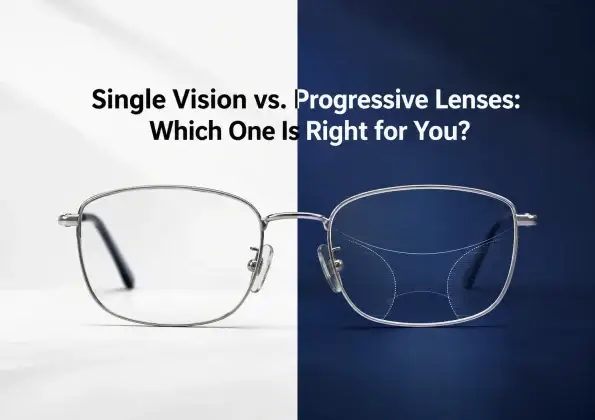
Choosing the right lens is one of the most consequential — and most confusing — decisions a glasses buyer makes. Do you need a simple single vision lens, or should you invest in a progressive lens that handles distance, intermediate, and near vision all at once? The answer depends on your age, your prescription, and how your eyes are actually changing over time. Here’s a data-backed breakdown to help you decide.
Why This Decision Matters More Than Ever
Vision correction needs shift with age, and one condition in particular is driving a large share of new lens purchases worldwide: presbyopia, the natural, age-related decline in the eye’s ability to focus on nearby objects. It typically begins in the early-to-mid 40s and affects nearly everyone eventually.
The scale is significant. Globally, an estimated 1.8 billion people are presbyopic, and of these, roughly 826 million have uncorrected near-vision impairment simply because they haven’t been fitted with the right lens. In India specifically, studies in rural populations have found presbyopia rates as high as 42.9% among adults aged 35 and older — meaning a large share of India’s adult population will, at some point, need to choose between single vision reading correction and a progressive lens.
Single Vision Lenses: The Basics
A single vision lens corrects one field of vision — either distance, intermediate, or near — with one uniform power across the entire lens. This makes it:
- Simple to adapt to. No learning curve; the entire lens surface is usable immediately.
- Ideal for a single, clear-cut vision problem — nearsightedness, farsightedness, or astigmatism alone, without presbyopia.
- More affordable, since the lens design and manufacturing process is less complex.
The limitation: if you also need near-vision correction (common after your early-to-mid 40s), a single vision lens for distance won’t help you read a menu or a phone screen. You’d need a separate pair, or a different lens type entirely.
Progressive Lenses: The Basics
A progressive lens blends multiple prescriptions into one lens — distance vision at the top, intermediate in the middle, and near vision at the bottom — with a smooth, invisible transition between zones (unlike older bifocals, which have a visible dividing line). This makes it:
- A single pair for all distances — no switching glasses between reading, screen work, and driving.
- More natural-looking, since there’s no visible line across the lens.
- The standard recommendation once presbyopia sets in alongside an existing distance prescription.
The trade-off: progressive lenses require an adaptation period, precise fitting (frame height and pupil measurements matter more here than with single vision), and a higher price point due to the more complex lens design.
The Adoption Gap: Where India Stands
Here’s where the data gets genuinely interesting for Indian buyers. Despite presbyopia being widespread, progressive lens adoption in India remains far below its potential. Research estimates that fewer than 15% of presbyopic patients across South Asia currently use progressive lenses as their primary correction — compared to over 60% in Western Europe and Japan.
A clinical study conducted in India found that while 65.2% of presbyopic patients were aware progressive lenses existed, only 19.3% actually used them, and a further 15.9% were still relying on basic single vision reading glasses despite needing correction across multiple distances. The most common reasons cited for avoiding progressive lenses were lack of awareness, cost concerns, and difficulty adapting — not dissatisfaction with the lenses themselves.
This gap represents genuine underserved demand: a large population that needs progressive correction but hasn’t yet made the switch, largely due to information and access barriers rather than the lens technology itself.
Single Vision vs. Progressive: A Quick Comparison
| Factor | Single Vision | Progressive |
|---|---|---|
| Corrects | One distance (near, intermediate, or far) | Distance, intermediate, and near — all in one lens |
| Best for | Myopia, hyperopia, or astigmatism without presbyopia | Presbyopia combined with an existing distance prescription |
| Visible lines | None | None (unlike bifocals) |
| Adaptation period | Minimal | 1–2 weeks typically |
| Fitting precision required | Standard | High — frame height and pupil position matter significantly |
| Price | Lower | Higher |
How to Decide
- Under 40, with a single clear vision problem (nearsighted, farsighted, or astigmatic): a single vision lens is almost always the right, cost-effective choice.
- Over 40, and starting to hold your phone further away to read it: this is the classic early sign of presbyopia. If you already wear distance glasses, a progressive lens will likely serve you better than juggling two pairs.
- Already using reading glasses and distance glasses separately: a progressive lens can consolidate both into one pair — worth discussing with your optometrist.
The Cracia Take
Given how widespread presbyopia is — and how underserved progressive lens adoption remains in India — getting this choice right matters more than most buyers realise. At Cracia, every lens is built around your exact prescription (SPH, CYL, Axis, ADD, and PD), whether that’s a precisely matched single vision lens or a properly fitted progressive. If you’re unsure which category applies to you, our team can help you match your prescription to the right lens type before you buy.
Explore Cracia’s single vision and progressive lens range at cracia.in.
Sources: Healio Epidemiology (Presbyopia); Eye Health Central Presbyopia Statistics 2026; Indian Journal of Clinical and Experimental Ophthalmology (Sah et al., 2025); DataIntelo Progressive Lenses Market Research Report 2034